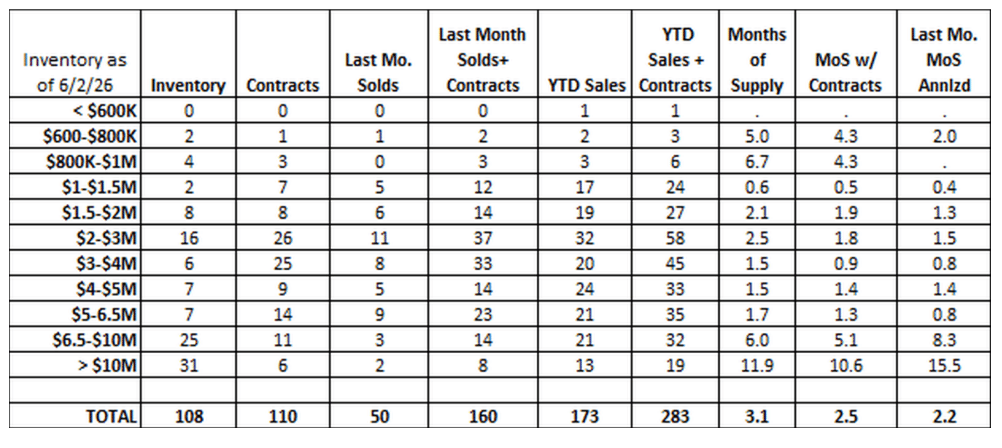
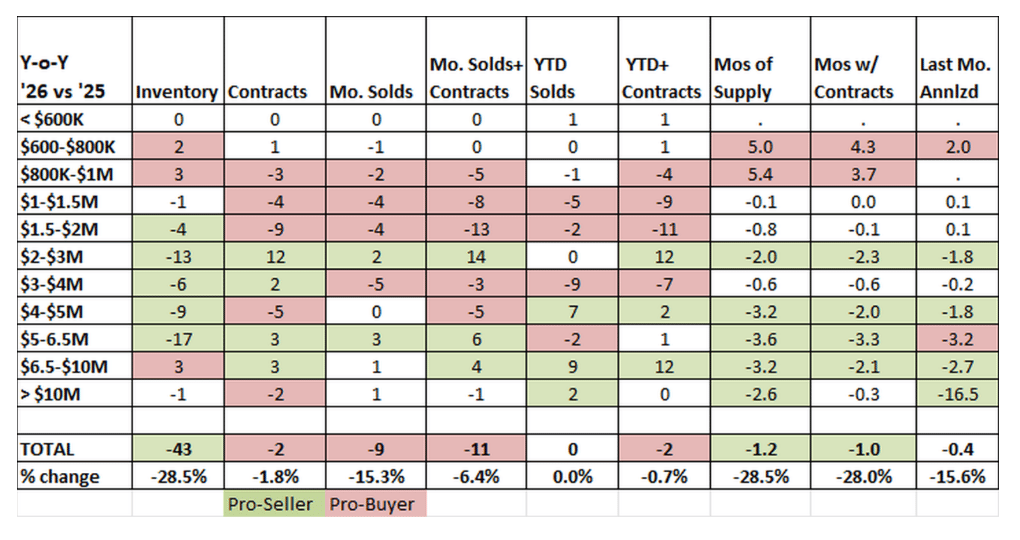
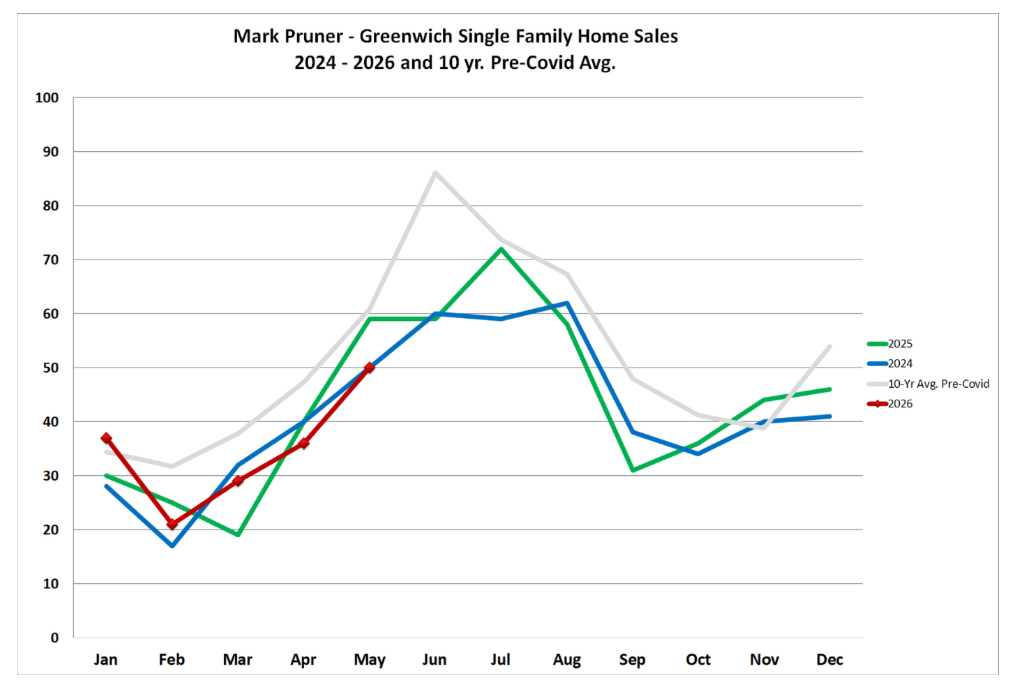
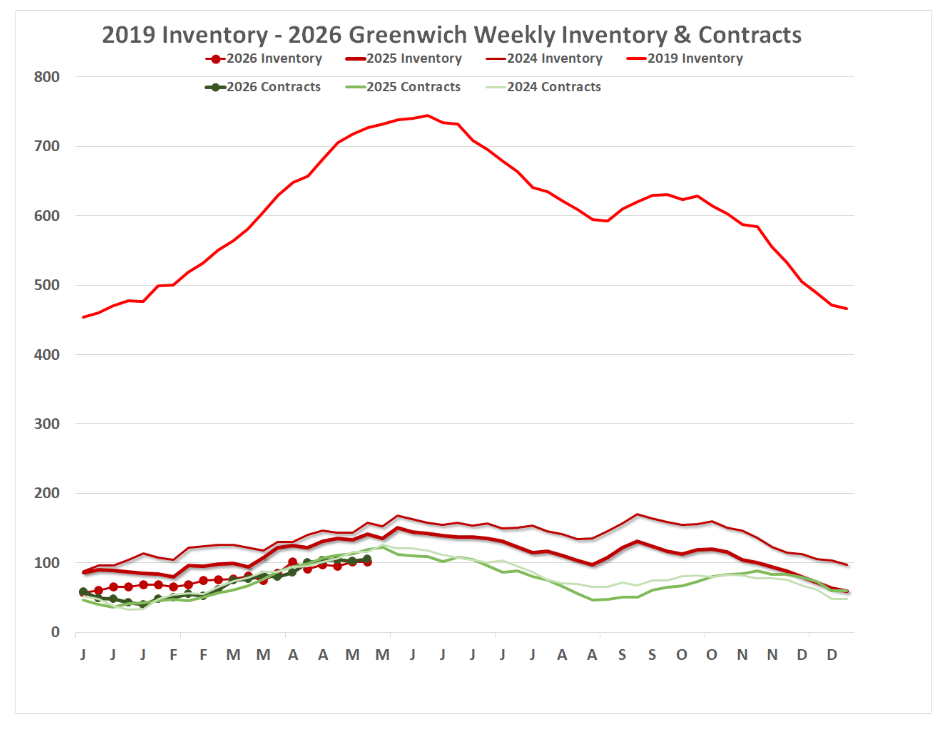
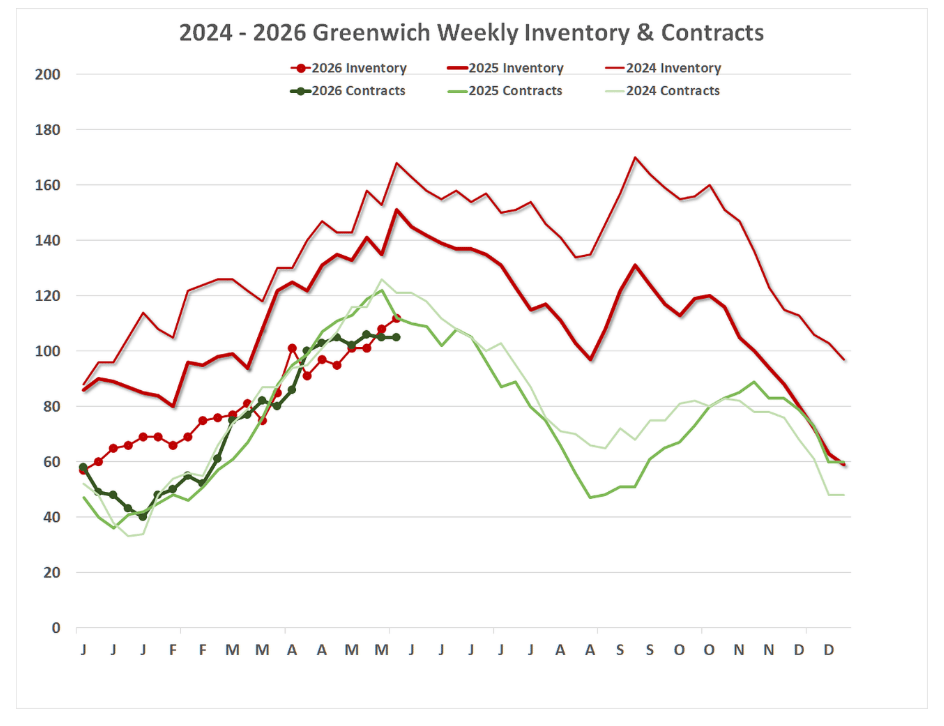
So far, 2026 has been much like 2025, but worse. Through the end of May, we have had 173 sales, the exact same number that we had in 2025. In May 2025, our median sales price was $3,200,000. In May 2026, the median sales price was $3,600,000, or an annual increase of 12.5%. The median sales price per square foot has gone from $792/sf to $897/sf, or a slightly larger 13.3%. At the same time, our inventory went down from 151 single-family homes last year to only 108 houses this year, or a 28.5% drop. Our contracts are down only 2 from 112 contracts last year to 110 contracts as of the end of May this year.
All of that actually sounds pretty good. Our prices are up 13% in one year, and sales are flat even though our inventory is down 28.5%. That is really remarkable. The reason that it is worse is that this market is not sustainable. We can't keep having prices go up so fast, year after year, and at the same time, have supply continue to drop by double digits every year.
I know all you Friedman economists are saying this is just supply and demand, and the invisible hand of the market is dictating prices. The problem is just when will the hand of the market finally start bringing prices and supply back into balance? Since 2019, our median sale price is up 93%, yet we are not seeing these increased prices bring more houses on the market.
Now, my brother and fellow Greenwich Streets Team member, Russ, who has been doing this for 39 years, argue that higher prices did bring more inventory on. In Covid our sales went from 526 sales in 2019 pre-Covid, to 861 sales in 2020, the first year of Covid, to an all-time high of 1,006 sales in 2021. If that wasn't supply responding to more demand and higher prices, what was?
Russ is right, fear of Covid drove people living in high density cities with shared common hallways and elevators drove people to the open, green spaces of suburbia, with Greenwich being the best of available options. Luckily for these buyers, Greenwich had hundreds of unlisted houses in our shadow inventory. Enough to meet much of this fear-driven, heightened Covid demand. These post-Great Recession sellers were the owners who had waited out declining prices in backcountry and mid-country and the small price gains in much of the rest of the town. When prices turned up, they were ready to sell.
Then along came 2022, which was a transition year. We had a very close to average 639 sales. The next two and a half years have been the post-Covid era of low inventory, leading to below-average sales. We have averaged 515 sales per year, compared to our 21st Century average of 651 sales per year. The problem is that we can't create much new single-family home inventory from vacant land.
Nearly every lot that could have had a house built on it has a house on it. Practically all new construction is preceded by the destruction of a house. The end result is that there is no net game in the number of houses, nor in the number of buildable lots. Yes, a few owners of marginal vacant lots are willing to roll the dice and try to build, but these lots have issues. A gentleman bought four acres in backcountry for a couple of hundred thousand dollars. He got this "bargain" because the property is 90% wetlands. Chances he can build are very slim, but hope, for some, springs eternal.
Septic issues also lead to unbuildable issues. If you don't have two feet of good soil, the Health Department will not let you build an engineered system where you bring in enough soil to build up the leaching fields that you need for a new house and the reserve fields that are also required. Lot shape is also a killer. If your lot can't contain a circle that ranges from 100' to 300' feet in diameter for the larger zones, you are going to have to apply for a variance. (Under a half-acre, the circles change to rectangles with the long side from 85' to 100'.)
So, what does the market do when the demand is there, but you can't create supply? It creates another type of supply. In the next three years, we may have over 200 new condos and apartments come on the market in the downtown area and potentially 198 more in backcountry. The odds are that they will sell quickly, as buyers really want new. Then again, it's amazing how high some developers price new construction, leading to over a year in marketing.
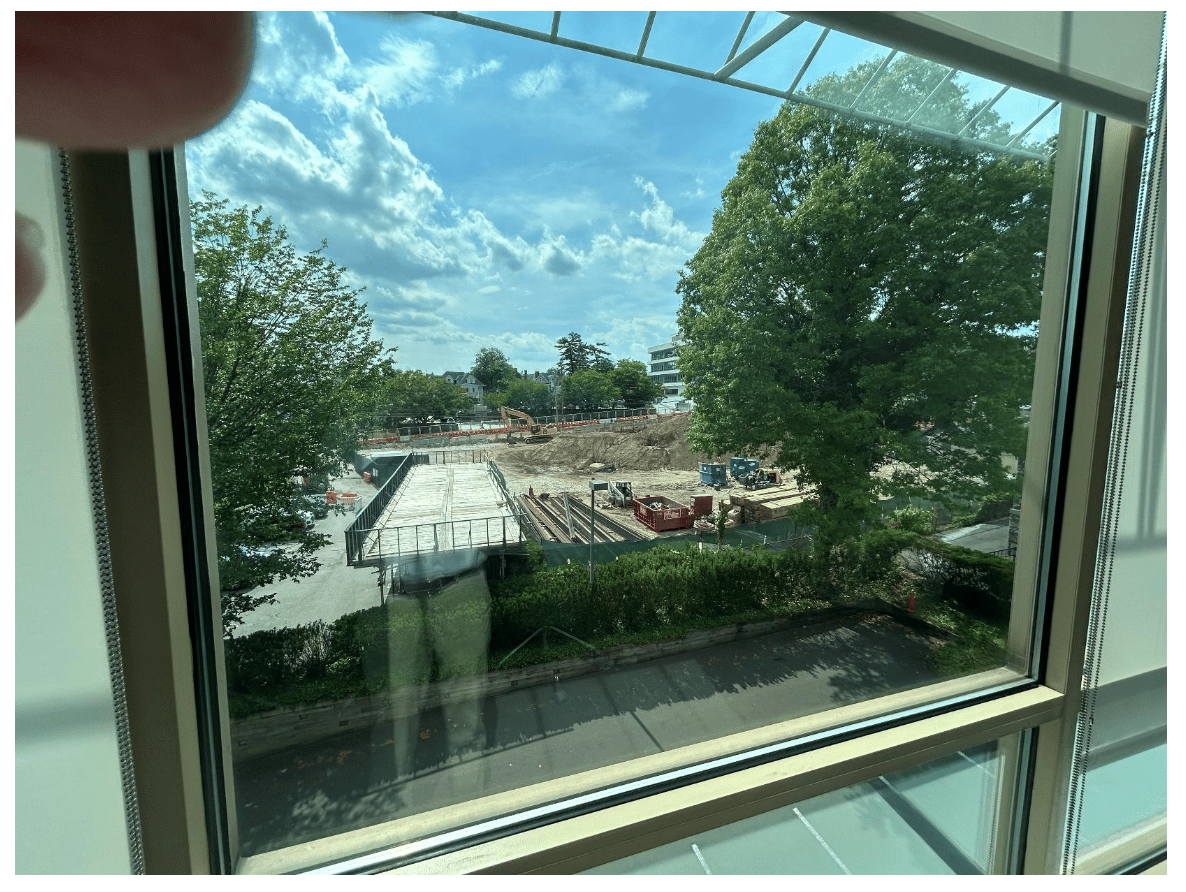 The Benedict Court project out of one of our Compass conference rooms. It's been surprisingly low noise for a project of this size.
Many of these projects used 8-30g to get built. As a result, 30 and even 40% of these units have to be affordable units. Connecticut General Statute. 8-30g requires that 30% of these units have to be affordable and also comparable to the other market rate units. This means that a few families get the bargain of a lifetime, as they can buy units comparable to the other units going for prices that can be over $5 million. The problem is that in the same space that you could house three families in need of affordable housing, you house only one. If you took that same money and built the affordable housing in Norwalk or Bridgeport you could have built 4 or 5 affordable units, not just one.
The upstate legislators feel that expensive towns should provide their fair share of housing for working people, which got enacted into law this year in Connecticut. On the flip side, you get less housing units. Conversely, if you put all the affordable housing in distant cities, you get even more crowded highways, when the portion of I-95 in Fairfield County is already the most crowded highway in the U.S. Remote affordable housing also means that emergency personnel live in Danbury and Long Island. These critical personnel may not be able to get here in a weather emergency. There is not an easy way to resolve this.
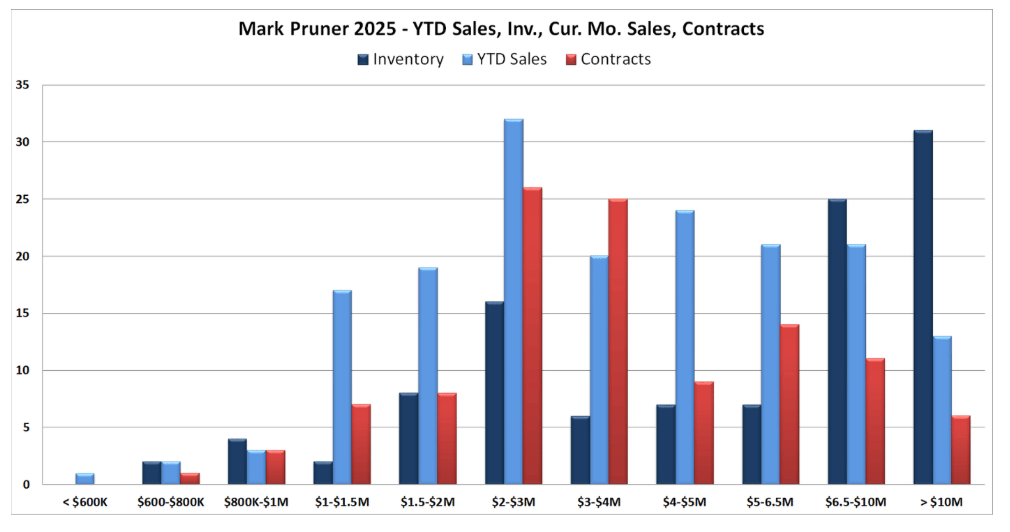
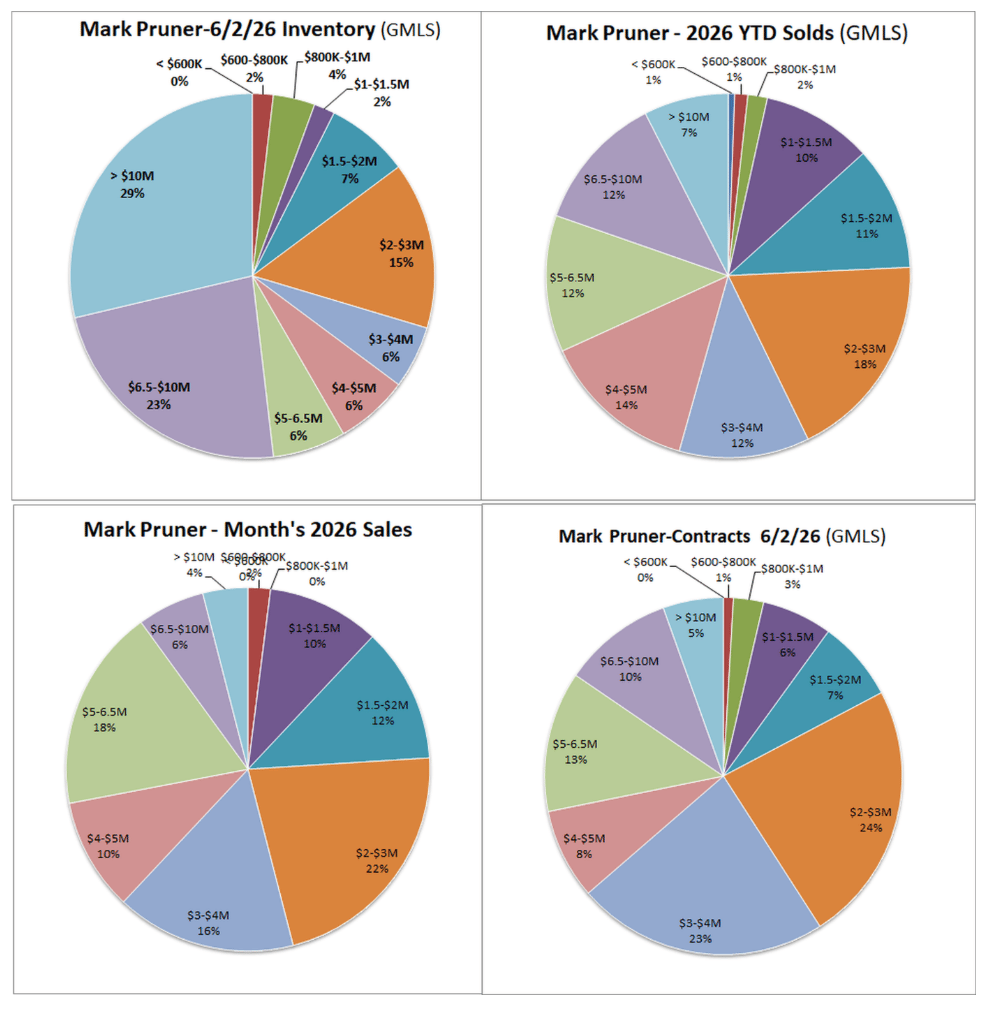
Meanwhile, back in Greenwich, in May 2026, we eked out 50 monthly sales, ending with an inventory of only 108 sales. May 2026 sales were down 9 houses from last May. Under $4 million, our sales were down even more. We had 14 fewer houses sell. By the end of May, we only had 38 houses on the market in that price range. This trend will continue as between $800K and $2M, our contracts are down 16 contracts from last year. This is a drop of 47% in contracts in our lower price range. Below $800K, we only have 1 contract and 1 sale in May, with twice that in inventory with 2 listings.
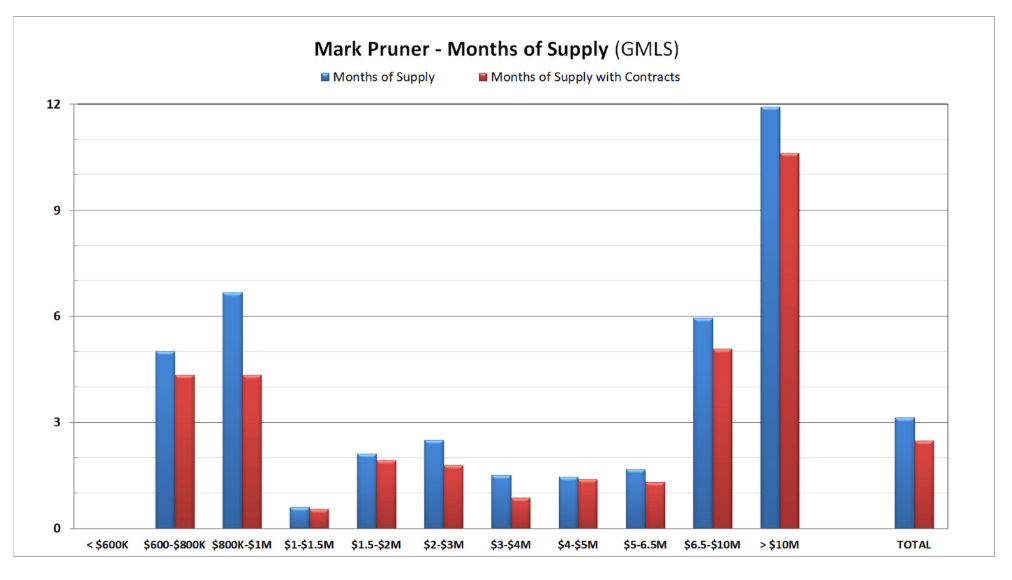
Due to the law of small numbers, our increase of inventory from $600K - $1M from 1 house last year to 6 houses this year meant that months of supply went from 0.6 months in 2025 to 5.8 months of supply in May 2026. Expect months of supply to drop by several months in June as these houses get sold, assuming that we don't get more inventory.
The rest of the year is up in the area. This is the week that inventory has peaked in the post-Covid years. This year, Inventory has gone up for the last two weeks. If it continues to go up in June, then we may finally break out of the relentless decline in listings of the last 30 months.
Only time will tell.
Mark Pruner is a Realtor with Compass Connecticut in Greenwich and a founder with Russ Pruner and Dena Zarra of the Greenwich Streets Team. He can be reached at 203-817-2871 or [email protected].