Is Greenwich, CT a Buyer's or Seller's Market in 2026?
Russell Pruner & Mark Pruner September 11, 2026
Market Report
Russell Pruner & Mark Pruner September 11, 2026
Market Report
Ask a local homeowner whether their Greenwich house is in a buyer's or seller's market, and right now, most of them would say a seller’s market, and some of them would be right. Greenwich isn't one market. It's dozens of small ones packed into 48 square miles, and in 2026 the lines between them are sharper than usual. Here's how to tell which side of the table you're sitting on, based on where you're looking and what you're trying to do.
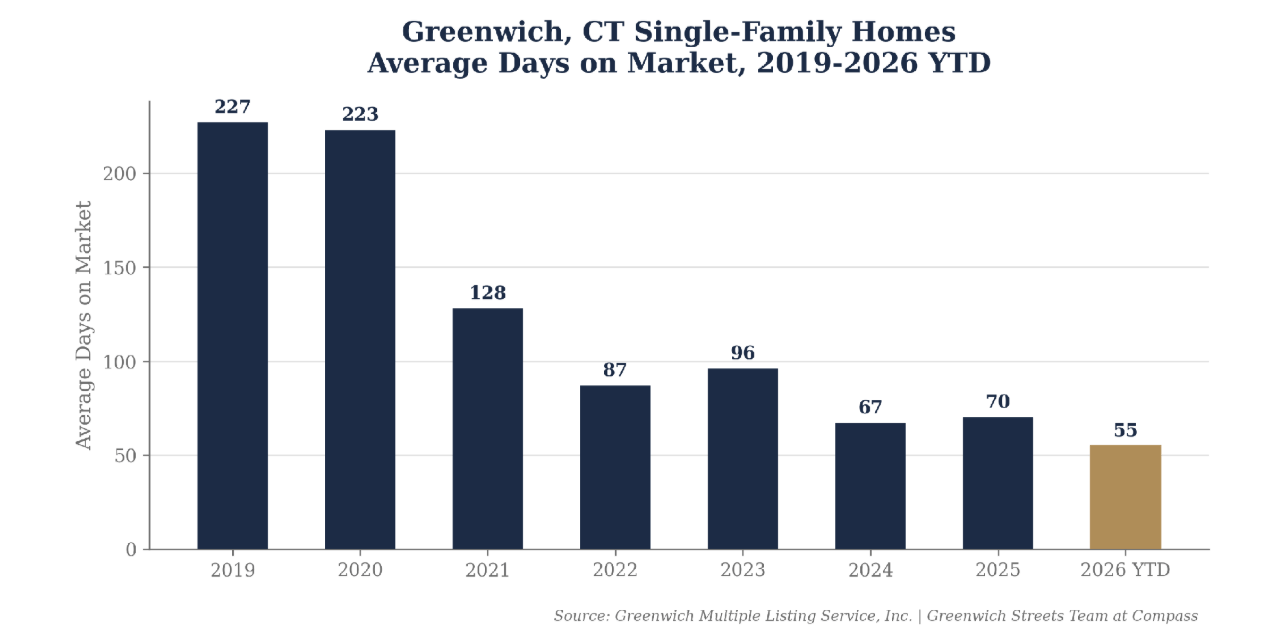
It comes down to a few numbers working together: how many homes are for sale, how fast they're selling, and what they're selling for relative to the asking price. As a rule of thumb, homes moving in well under 45 days with multiple offers are a seller's market. Homes sitting for 70 days or more, with room to negotiate below list price are in a buyer's market. In between is a balanced market. All of Greenwich rarely sits neatly in one category, which is exactly why the headline answer can be misleading.
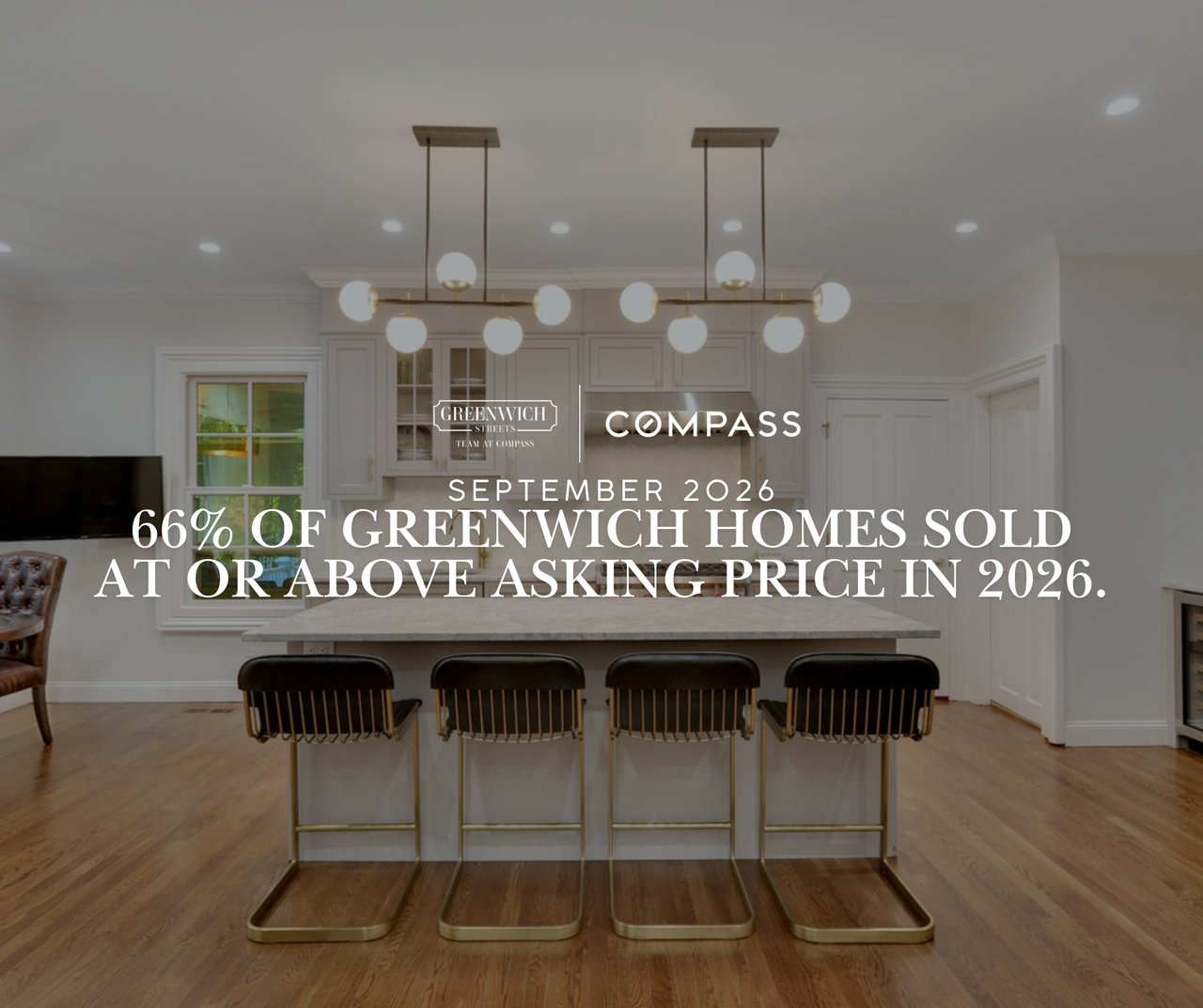
Overall, the advantage for most houses in Greenwich still sits with sellers, particularly in well-priced homes that are in move-in condition. Inventory has stayed thin throughout most of 2026, and well-positioned listings are drawing quick, competitive interest with 66% selling at or above asking price this year. Our average days on market for 2026 is only 55 days and our median days on market is a minuscule 17 DOM. That said, "well-positioned" is doing a lot of work in that sentence.
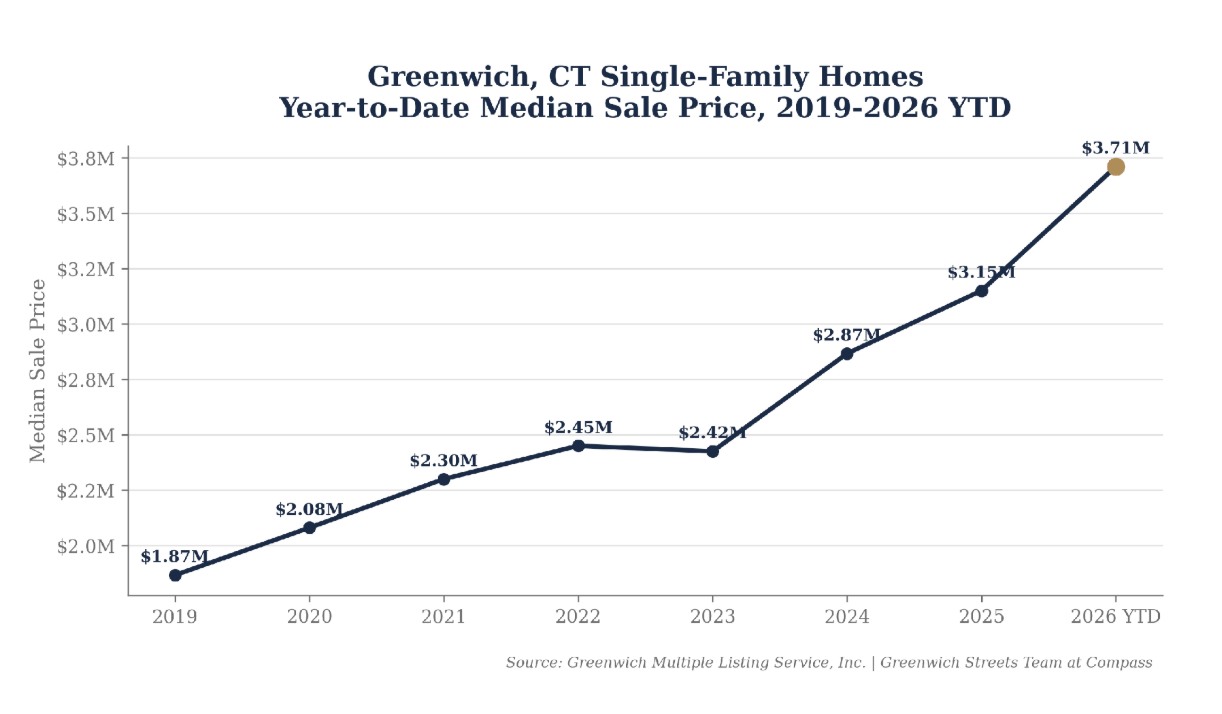
No, and this is the part a generic market snapshot misses. Neighborhoods like Old Greenwich, central Greenwich and Cos Cob have stayed genuinely competitive, with homes moving quickly and often receiving more than one offer. Backcountry and the larger estate sections tell a different story.
Homes there tend to sit longer and sell with more room to negotiate, simply because the buyer pool for a multi-acre, multimillion-dollar property is smaller than the pool for a well-located, mid-priced colonial closer to town. Having said that those high-end homes may be having their second best year ever. Two sellers a mile apart can be living in two completely different markets.
In reality, your house is a market of one. Its condition, style, size, ability to expand, size of the lot, topography and its land use restrictions are all different from other houses in your neighborhood. This is where you, as seller, your agent and even your attorney figure out what your house’s pluses and minuses are.
The larger the number of people that like your house the better. Conversely, if your house needs a lot of work, is a style that is not in favor, has lots of bedrock outcrops, is on a long skinny lot, with deed restrictions and next to I-95 it’s going to appeal to a smaller group of people. It’s really a buyer’s market for your house and working with your agent to come up with a price and a marketing strategy is key.
Pricing accurately from day one matters more than ever. In the neighborhoods and price points where demand is strong, a well-priced home in good condition can generate real competition quickly. Overprice it, even slightly, and you risk sitting on the market long enough to lose that recently listed momentum, which changes how buyers perceive the home. With high pricing and a poor marketing plan in a hot neighborhood, your house still has a good chance of selling, but you will leave a lot of money on the table.
Where inventory is thinner and price points are higher, patience and a strong presentation matter more. Also, seriously consider that first offer, that may seem low. It may be the best one you get if your house is in a buyer’s market of one.
Know which market the house you want is actually in before you make an offer. If you're competing for a move-in-ready home in a high-demand location, you'll likely need to move decisively and come in strong. Low ball offers show weakness and only encourage other buyers.
If you're looking at a high end home or a home that's been sitting, you may have room to negotiate on price or terms. The mistake we see most often is buyers applying the same strategy across every neighborhood and every house, when the data says they shouldn't.
It varies significantly by neighborhood and price point. In-town and other high-demand areas are moving quickly, often in a matter of weeks or even days, while larger estate properties can take several months to find the right buyer. Then again, some prices are just ridiculous even for in-demand neighborhoods and will sit.
In competitive, well-priced segments, yes, this is very common. It's far less common at higher price points or in areas with more available inventory due to less demand.
For well-located, well-priced homes, yes, conditions are very favorable. We are presently in the tightest market ever in Greenwich. In the market of one, that your house is in, you need to take a deeper look. Check out not only how your neighborhood is doing, but also sales of houses with a similar style, which demographics your house appeals to, and all the factors affecting demand for your house.
Given how little inventory we have, the answer is still likely that this is a good time to sell. However, make sure that you take into account your specific neighborhood, price point, and how your home compares to what else is on the market.
Central Greenwich, Old Greenwich, and Cos Cob have consistently drawn strong, fast-moving buyer interest in 2026. Byram and Pemberwick are hot due to the larger number of people that can afford these neighborhoods. Backcountry and larger estate have generally offered more breathing room.
Inventory levels, stock market performance, mortgage rate movement, and tax law changes will be four of the biggest factors to watch. We track these closely.
Five years ago, I got my brother Mark to join me, and with Dena Zarra, Tim Agro, and Felipe Dutra, we are the Greenwich Streets Team at Compass. I can be reached at 203-524-4998 or [email protected]. Mark can be reached at 203-817-2871 or [email protected]. The Greenwich Streets Team is in the top 1.5% of real estate professionals nationwide, per Real Trends Verified.
Stay up to date on the latest real estate trends.

Blog
Blog

Blog

Blog
Blog

Blog
Blog

Blog
Market Report
Discover the best places to live across Greenwich
We are a dedicated group of Greenwich natives. We have a deep passion for our hometown and enjoy everything the town offers its residents from the beach front to the backcountry. That is why we don’t find you just any home, we find you the right home.
MARK PRUNER
DENA ZARRA
RUSSELL PRUNER
COMPASS
200 Greenwich Ave
3rd Fl Greenwich, CT 06830